NEWS: Roundup of National New on Isolated Confinement, June/July 2013

Compiled by the CAIC Research Committee

July 5, 2013

Amnesty International is urging California to reform its ‘inhumane’ solitary confinement units before the hunger strike which is planned for July 8, in protest against the failure of the California Department of Corrections and Rehabilitation to carry out reforms pledged a year ago. The men planning the hunger strike have said that “Rather than improving, conditions have actually significantly deteriorated.”http://www.amnesty.org/en/news/usa-california-urged-reform-inhumane-prison-units-ahead-hunger-strike-2013-07-05

July 3, 2013

On July 8th, prisoners at Pelican Bay Security Housing Unit (SHU) and throughout the California prison system will begin a hunger strike, along with work stoppages to compel the Governor and the California Department of Corrections and Rehabilitation (CDCR) to end long-term solitary confinement and meet four other core demands. http://prisonerhungerstrikesolidarity.wordpress.com/

July 1, 2013

Following the closure of California’s Valley State Prison for Women (VSPW) for use as a male facility, the women were sent to Central California Women’s Facility (CCWF) which is currently at 174.9 percent capacity, housing approximately1,500 more people than it was designed for. Many of the women are extremely distressed by their conditions of confinement including extended placement in Administrative Segregation (Ad Seg) for sometimes just because they are victimized by other inmates. http://solitarywatch.com/

June 27, 2013

The California Correctional Peace Officers Assn. this week asked the judge to include it as a party in the Pelican Bay lawsuit over how long the state may keep people incarcerated locked up in solitary confinement. The guards union contends that decisions on who is put into Pelican Bay’s Security Housing Unit, and how long they are kept there are a matter of security that affects the safety of union members throughout the state prison system. http://articles.latimes.com/2013/jun/27/local/la-me-ff-prison-guards-weigh-in-on-solitary-confinement-20130627

June 26, 2013

Sarah Shourd, who spent more than a year in solitary confinement in an Iranian prison, has joined Solitary Watch. She is beginning work on a play featuring voices from solitary confinement, which she hopes to present across the country.  The presentations will be followed by meetings with local politicians, prison officials, activists, survivors and their families. http://solitarywatch.com/2013/06/26/solitary-survivor-sarah-shourd-joins-sw-to-produce-play-featuring-voices-from-solitary-confinement/

June 24,2013

In a closed meeting last week, the Senate Armed Services Committee approved a bill that would relax legal restrictions on the transfer of detainees out of the military prison atGuantánamo Bay giving President Obama much greater flexibility as he tries to revive his effort to close the facility. If the bill were to become law, detainees could be sent to the United States for necessary medical treatment, for continued detention in a different prison, or for prosecution. It would also ease statutory limits on transferring detainees to other countries. http://www.nytimes.com/2013/06/25/us/bill-allowing-guantanamo-detainees-to-be-moved-advances.html?_r=0

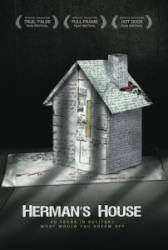
Herman Wallace, 71, the subject of the film Herman’s House, has been diagnosed with liver cancer and is currently being held in a locked prison hospital room. Mr. Wallace and Albert Woodfox, two members of the Angola 3, who have been in Solitary Confinement in Louisiana, for more than 40 years have have been fighting for justice for much of that time with the assistance of Amnesty International. http://solitarywatch.com/

June 21,2013

Legislators in Massachusetts have proposed bills that would stop corrections officers from disciplining inmates with long periods of isolation. The bills would require that people in prison who are facing disciplinary segregation be given a hearing within 15 days of being confined and every 90 days afterward to evaluate behavior. Solitary confinement sentences would be limited to six months for all but the most extraordinary circumstances. Also included in the bills are better access to mental health examinations and more rehabilitation. http://www.bostonglobe.com/metro/2013/06/20/mass-lawmakers-call-for-reform-solitary-confinement-protocol-state-prison/Juxz3x5X7ULVoe9w691YAN/story.html

June 20, 2013

Over 50 human and civil rights groups around the country have asked the U.S. government to invite Juan Méndez, the U.N. special rapporteur on torture, to visit the United States to examine, among other things, the practice of solitary confinement. Despite Mr. Méndez’s multiple requests to investigate the overuse of solitary confinement in the United States, the U.S. has, to date, failed to extend him an invitation. http://www.aclu.org/blog/prisoners-rights-human-rights-national-security/rights-groups-government-allow-un-torture


June 18 & 21, 2013

In The Lancet medical journal,152 doctors signed a letter in response to the Guantanamo prisoners’ request for outside medical treatment and counsel, asking to be able to visit the prisoners and provide independent health care noting that since the detainees on hunger strike do not trust their military doctors, they are unlikely to comply with current medical advice. Also Senator Dianne Feinstein, chairwoman of the Senate Select Committee on Intelligence, wrote aletter to Defense Secretary Chuck Hagel, urging the government to “reevaluate the force-feeding … to put in place the most humane policies possible.” However, the practice of force-feeding has apparently not raised medical concerns from the prison doctors themselves. http://press.thelancet.com/guantanamoletter.pdf  http://www.guardian.co.uk/world/interactive/2013/may/31/guantanamo-detainees-protest-letter   https://www.aclu.org/files/assets/coalition_letter_to_hagel_on_gitmo_force-feeding.pdf   http://dailycaller.com/2013/06/21/guantanamo-doctors-ok-with-force-feeding-prisoners/#ixzz2Wxq3xnpE

June 14, 2013

At the fifth World Congress Against the Death Penalty in Madrid, The Center for Constitutional Rights (CCR) and the International Federation of Human Rights (FIDH) released summary findings about the US’ use of the death penalty, based on missions to California and Louisiana. They conclude that not only the death penalty itself is a violation of human rights but so too is the way it is implemented, which constitutes torture and discrimination. Among the violations noted, was Louisiana’s use of solitary confinement for people sentenced to death. http://www.ccrjustice.org/newsroom/press-releases/human-rights-groups-release-preliminary-death-penalty-findings

June 13, 2013

An article in the New England Journal of Medicine declares the Guantanamo force-feeding unethical and urges physicians to resist orders to participate.  It also urges civilian physicians, professional organizations, and licensing boards to support those who do resist. http://www.nejm.org/doi/full/10.1056/NEJMp1306065

The Ontario Human Rights Tribunal has agreed to hear the case of a woman, who spent more than 200 days in segregation over the course of a year of custody at the Ottawa Carleton Detention Centre.  The case alleges that she was discriminated against based on both her mental illness and her gender, since a treatment facility has existed for a decade serving male inmates, but there is not any such service for women. http://www.cbc.ca/news/canada/ottawa/story/2013/06/13/ottawa-mental-illness-jail-women.html

June 11, 2013

Less than a month before statewide hunger strikes are set to resume, the California Department of Corrections has instituted a new policy at Pelican Bay State Prison which has resulted in  chronic sleep deprivation for prisoners in solitary confinement. The 2011 strike was called off in response to promises of improvements, but the people in prison gave notice that it would be resumed because those promises have been empty, and prison conditions have actually worsened. http://sfbayview.com/2013/sleep-deprivation-intensifies-torture-conditions-for-prisoners-in-advance-of-hunger-strikes-and-work-actions/

June 9, 2013

A Rastafarian man who spent more than 10 years in segregation for refusing to cut his hair said fears for his health and safety led him to give in last month.  Virginia Department of Corrections grooming policy, which they say is for health and safety reasons, requires that the hair of the men in prison be cut short. Rastafarians in the prison had long opposed the policy on the grounds that it is against their religion. Those who refused to comply were placed in segregation cells — several for more than 10 years. http://www.timesdispatch.com/news/state-regional/rastafarian-inmate-relents-on-haircut-after-years/article_f88c5840-eb05-5cce-b65e-482e0e6fabbe.html  http://www.washingtonpost.com/local/rastafarian-inmate-who-spent-more-than-10-years-in-segregation-cuts-hair-to-get-transfer/2013/06/08/cca3bd6e-d072-11e2-9772-6fcf660e8c49_story.html

June 7, 2013

A federal judge has ordered the state of California to provide deaf people in solitary confinement with sign-language interpreters, noting “inmates there are 33 percent more likely to kill themselves.”  The court found that the corrections department has not complied with previous orders issued between 1996 and 2002 and thus is still in violation of the ADA.  However it refused hold the state in contempt, at this time. http://www.courthousenews.com/2013/06/07/58332.htm

Among the topics in the film, Dirty Wars, which opened in NYC today, is a discussion of the US drone killing of Anwar al Awaki, the radical Muslim cleric.  Mention is made of the fact that Mr. al Awaki had been arrested in Yemen at the request of the US and held in solitary confinement for 17 months, which contributed to his increasingly radical opposition to this country.

June 6, 2013

The U.S. Southern Command has requested additional guards for the prison camps at Guantánamo, with the goal of reaching a 2,000-strong staff, because, they say keeping the prisoners in single cell confinement requires the guards to do more work.  They have already gotten medical reinforcements to help deal with the hunger strike — a doctor, nurses, and corpsmen. http://www.miamiherald.com/2013/06/05/3434821/guantanamo-prison-getting-reinforcements.html#storylink=cpy
VOICES: The Loneliest Place in the World

By Shawn Smith. Reprinted from Solitary Watch.

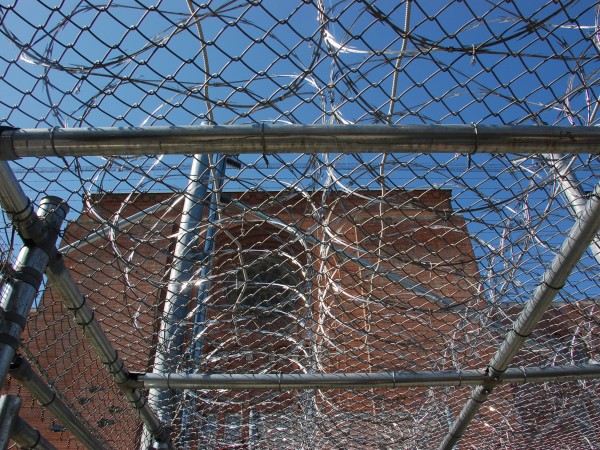
elmira2The following essay is by Shawn Smith, who is serving time for drug sales and assault in New York. He is one of some 4,500 individuals currently being held in isolated confinement in the state’s prison system. In a letter to Solitary Watch, he writes “I’m so lonely that I dream of human contact with the outside world…and I was hoping that you could find it in your heart to embrace me as a friend and help me get my essay up on your website. So that people can become aware of the levels of injustices and sorrow that has been bestowed upon me involving my solitary confinement experience…I feel so hopeless that I’ve spilled out my heart into this essay and I’m sending it to you in hopes that some change can come to me from it.”  Shawn Smith’s mailing address is #07A1605, Elmira Correctional Facility, P.O. Box 500, Elmira, New York 14901-0500. –James Ridgeway

.  .  .  .  .  .  .  .  .  .  .  .

Four walls! A ceiling! And a floor eight by ten feet in dimension! In my eyes, this is the worst torture device in the history of the universe! Within this small enclave many men have fallen apart and broken down mentally into a deep stage of sorrow. That has made us (myself included) drop to our knees with lakes of tears under our eyes that cascade down our face. As we ask God “Why me? Why must I suffer this unbearable pain and burden?”

This place has made me feel so hopeless that I’ve dosed on pills two times and was rushed to the hospital where they pumped my stomach clean of the many painkillers and anti-depression pills that I digested in hopes of going to a better place! I’ve hung up with a self-made noose and sliced my wrist, because this place has driven me to the brink of insanity and I felt like I would rather be dead than live like a dog in a cage at the unwanted animal shelter.

In this place, I’ve lost and found my sanity time and time again. What really shook me up and made me find the inner strength to fight for the willpower to want to live my life and fight to survive in this place was when I saw the COs carry a friend I made in the brother in the cell next-door to me away in a black bag!

[Read more…]

NEWS: NYC Board of Correction Rejects Regulating Use of Solitary Confinement

Press Release from the Jails Action Coalition.

BOC Meeting

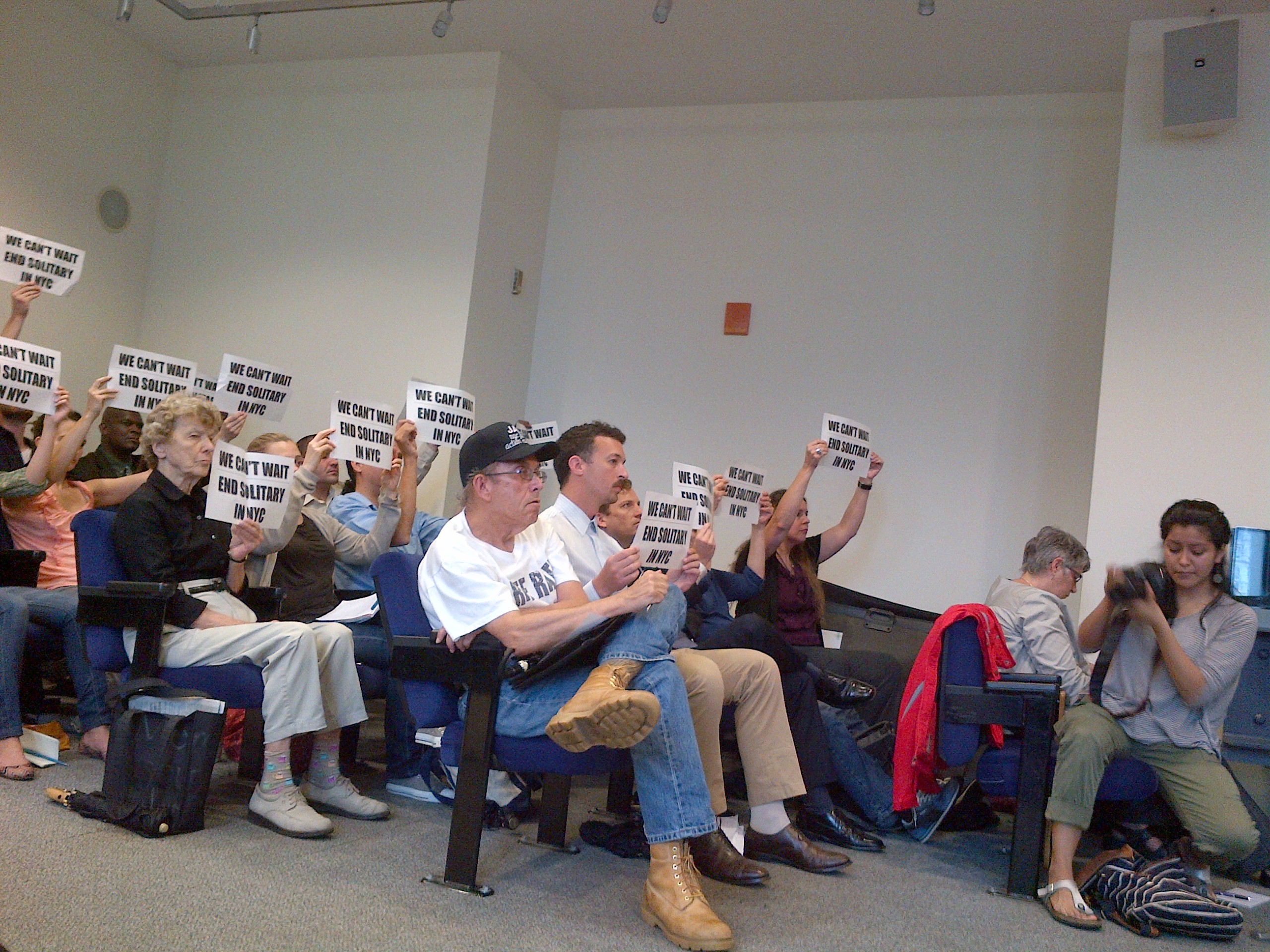
JAC members at the Board of Correction meeting.

June 3 – Today, the Board of Correction denied a petition to adopt rules regulating the use of solitary confinement in jails, also known as “punitive segregation,” and decided to appoint a committee to study the practice- delaying a decision until its September meeting.

On April 9th, the NYC Jails Coalition submitted a petition to the Board of Correction asking the Board to adopt rules regarding the use of solitary confinement. The proposed rules would’ve implemented the following:

§ Prohibit DOC from placing people with mental and physical disabilities, juveniles, and young people in isolated confinement;

§ Limit the reasons for which a person can be placed in isolated confinement so that it is only used as a last resort to prevent violent conduct;

§ And increase the amount of daily out-of-cell time for those placed in isolated confinement.

At its May 13th meeting, the Board, which has oversight authority to adopt rules, postponed voting on the petition and the proposed rules until June 3rd. Today, the Board denied rulemaking.

The DOC routinely places people in solitary confinement in response to a variety of infractions. Contrary to the national trend toward reducing the harmful use of isolation in jails and prisons, the New York City Department of Correction (DOC) expanded its punitive segregation capacity 27% in 2011, and another 44% percent in 2012. This expansion has left NYC with one of the highest rates of solitary confinement in the country. In fact, the DOC has more punitive segregation cells than it did in the 1990s, when it housed many thousands more people than it does today.

“We are extremely disappointed with the Board of Correction’s vote to deny the petition for rulemaking on solitary confinement and further delay a decision on the practice. Isolating a person in a cell for up to 24 hours a day without any mental stimulation or human contact causes serious psychological and developmental harm. Yet the Department of Correction is currently incarcerating at least 1000 people, including teenagers and people with mental and physical disabilities, in these conditions,” said Jennifer Parish, Director of Criminal Justice Advocacy at the Urban Justice Center Mental Health Project, and member of JAC. “It is critical for the Board to adopt rules curtailing the use of solitary confinement. We hope that the Board will initiate rule-making at its September meeting.”

[Read more…]

NEWS: Roundup of National News on Isolated Confinement, May 2013

Compiled by the CAIC Research Committee.

May 2013

Numerous advocacy and religious organizations are supporting a sign-on campaign for a letter asking Attorney General Eric Holder to ban the practice of holding youth in federal custody in solitary confinement.  http://activism.thenation.com/p/dia/action3/common/public/?action_KEY=10781

May 30, 2013

The ACLU, the Southern Poverty Law Center, and the Law Offices of Elizabeth Alexander filed a federal lawsuit in May 2013 on behalf of individuals imprisoned at the East Mississippi Correctional Facility (EMCF), describing the for-profit prison as hyper-violent, grotesquely filthy and dangerous. http://www.aclu.org/prisoners-rights/dockery-v-epps

May 23, 2013

A Cree woman from Saskatchewan who felt she was losing her mind while being held in solitary confinement in federal prisons has settled a lawsuit that claimed she was being treated illegally and inhumanely. But she said being sent into solitary confinement didn’t help her face up to her past–it only increased her sense of hopelessness. In Canada, 23 per cent of the federal prison population is aboriginal, even though aboriginals account for just four per cent of the population. http://www.vancouversun.com/news/Cree+woman+settles+suit+over+solitary+confinement/8423271/story.html#ixzz2UoFut6jQ

Advocates for the closing of Guantanamo and the transfer of the men who will not be tried responded to Obama’s speech on national security, welcoming his stated reengagement on Guantanamo and his decision to lift the ban on transfers to Yemen. However they expressed disappointment with his comment that cleared men will only be released “to the greatest extent possible.” And, although Obama pledged to review detainees for transfer, in fact reviews have already happened as is evident in the fact that so many of the men have been “cleared.” Statements of disappointment also note his failure to take any concrete action. http://ccrjustice.org/newsroom/press-releases/center-constitutional-rights-responds-obama-drone%2C-gitmo-speech; http://www.rollingstone.com/politics/news/what-obamas-speech-means-for-guantanamo-20130523#ixzz2UoCLfdNG

In Texas, the House tentatively approved Senate Bill 1003, which would require a now-defunct legislative oversight committee to hire an independent party to review solitary confinement conditions in Texas prisons and juvenile lockups. http://www.texastribune.org/2013/05/21/time-fading-bills-aimed-reducing-solitary-confinem/http://blog.chron.com/texaspolitics/2013/05/solitary-confinement-of-youths-to-be-tracked/

[Read more…]

NEWS & EVENTS: Board of Correction to Vote on Solitary Reform in New York City Jails

The following is an open letter from the NYC Jails Action Coalition regarding the upcoming vote by the New York City Board of Correction, the body that oversees city jails, on a proposal from JAC that would bring significant reform to solitary confinement practices. Click here for an earlier story on this subject.

Dear Supporters:

Thank you again for urging the New York City Board of Correction (BOC) to adopt rules regarding the use of solitary confinement in the NYC jails. The BOC discussed the Jails Action Coalition (JAC) petition at their May 13, 2013 meeting but delayed making a decision until a specially scheduled meeting now set for June 3, 2013.

On June 3, the BOC will decide between the following:  1) commence rule-making (including consideration of the proposal provided by JAC and any alternatives); 2) reject the JAC petition as premature and appoint a committee to study the issue of use of solitary confinement in the jails; or 3) reject the petition and take no further action.

Please urge the BOC to commence rule-making:

►Send a letter expressing your support for rule-making. (See the attached model letter, which can be sent directly to the Board and/or returned to us for delivery to the Board Members.)

►Attend the BOC meeting at 9 a.m. on June 3.

► Join JAC’s rally before the meeting at 8:15 a.m. at 1 Centre Street.  (See below for all the details.)

[Read more…]

NEWS: Solitary Confinement Is Just Criminal

By Karen Murtagh. Reprinted from the Albany Times-Union.

elmiraThe Times  Union recently published an opinion piece by the president of the prison  guards’ union responding to a published profile of Jeffrey  Rockefeller. Due to a near lifetime of serious mental illness, Rockefeller  landed in prison and spent half of his 40-month incarceration in solitary  confinement — where he ultimately tried to commit suicide.

Contrary to the assertion that solitary confinement (aka “special housing  units”) is used to isolate inmates who are a danger to others and themselves,  less than 16 percent of the 4,500 people in solitary in 2012 were there for  violent behavior.

Brian  Fischer, the recently retired corrections commissioner, has admitted that  “solitary confinement is overused.” The significant reduction or near  elimination of the use of solitary by Mississippi, Colorado, Illinois, Maine,  Ohio and Washington, without any impact on prison safety, belies the statement  that “SHUs are the only mechanism for removing dangerous inmates from the  general population.”

The disconnect here is the failure to differentiate between isolation and  separation. Certain individuals need short-term isolation for their own safety  or the safety of others, but the rationale for such isolation is to prevent  imminent harm, not to impose months, years, or decades of retribution and  mental deterioration.

At least one study has shown that the recidivism rate for those who have been  subjected to solitary confinement is 23 percent higher than those who have not.  More than 95 percent of incarcerated New Yorkers are ultimately released to our  communities. We are all safer when formerly incarcerated individuals lead  productive lives. Spending time in solitary confinement lessens the likelihood  that an individual will be psychologically prepared to do this.

Karen  L. Murtagh is executive director of Prisoners’ Legal  Services of New York.

VOICES: You Are Solitary Confinement

By Nicholas Zimmerman.

The following narrative and poem are by Nicholas Zimmerman, who is currently incarcerated at Attica. He has spent, in total, a decade in solitary confinement. The website maintained by his loved ones is  www.FREENicholasZimmerman.com. Thanks to CAIC member Desiray Smith for sharing his story.

You are the most profound form of Cruel and Unusual Punishment Know to mankind, yet the Eighth Amendment of the United States Constitution seems to have no effect on you?

You are only 6 feet by 8 feet in size, but your impact is devastating and long lasting.

You are a silent killer, slipping in and out of prison cells late at night to claim your next victim.

You are the Department of Corrections’ most effective weapon in inflicting mental and physical torture upon its captives.

Your existence is undeniable; you’ve been around for hundreds of years.

Numerous experts have complained about you for decades to no avail.

You are the cause of my depression, my high blood pressure, my anxiety, my sleepless nights, and my restless days.

I’ve watched you kill people with out laying a hand on them.

I’ve watched people hang themselves from your support beams within minutes of being in your clutches.

I’ve seen people slice and dice themselves with hopes of escaping your misery.

And I’ve also watched the Correctional Officers and Mental Health staff enjoy every minute of it.

You’re a Bitch in my eyes; not man enough to show your face and fight me one on one, but coward enough to attack me while I’m sleeping and inject fatal thoughts of suicide into my dreams.

Through lawsuits, maintenance, funding and security, you cause the taxpayers billions of dollars per year to stay afloat, yet they know very little about you and how unnecessary and counterproductive you really are.

Lately, you have been under fire by the media, however. But will this end your reign of terror? Only time will tell.

I’ve been battling you for the past 10 years and everyday I look at you and grin knowing that you are on your last leg. Your defeat is imminent, but your history will be legendary. Tomorrow you might be a thing of the past, but today at this very minute, as I write these words, you are torturing another soul and plotting your next murder.

And you legally get away with all of this simply because of who you are!

You are…

SOLITARY CONFINEMENT!

[Read more…]

NEWS: Bill Aims to Reduce Solitary Confinement in New York City Jails

By Josey Bartlett. Excerpted from the Queens Chronicle.

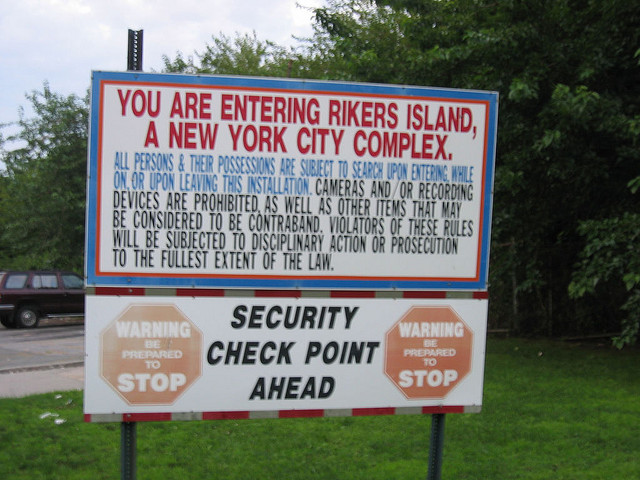
Rikers-Island-contrabandAbout 12 years ago Five Omar Mualimmak — who says his unique numerical name is the subject of a whole other article — was arrested on drug trafficking, possession of an illegal weapon, money laundering and tax evasion charges and sent to Rikers Island. Those charges were changed and dropped and then a few reissued, Mualimmak, 38, said, keeping him in the system for 11 years.

Once he was put in prison, a fight landed the Bronx man in solitary confinement.

“I got stabbed at Rikers,” Mualimmak said. “If you are a victim, it’s not where they care about you. Five people were involved in the fight and everyone was going to the box.”

This was just his introduction to solitary.

More brawls kept him there — 23 hours of time spent in a room where the light never turns off, and one hour, “maybe,” spent outside — for about five years. A family member sent him a book that the prison deemed an organizing device, Mualimmak said, and he was given more time in solitary.

“Mathematically it’s impossible to bring everyone outside,” he said. “It’s torturous. The yard is like a dog pen. Have you seen a dog kennel? It’s like that.

“To go out you have to be at your gate fully dressed for the rec run.

“Then they strip search you in your cell. Take off all your clothes, then from there you are cuffed, shackled around your waist, cuffed around the ankle, brought to another room where there are dogs and you are stripped again, then cuffed, shackled, cuffed.”…

The inside 23 hours of solitary confinement are spent pacing, sleeping — about half the time he slept, something much different from his current insomniac life — writing, drawing and reading — Mualimmak was allowed 10 books a month, which “ran like water” — and just spent being bored.

He watched other prisoners hold open the cell flap where food would come in, just for human interaction. That infraction broke solitary confinement rules and was penalized with more time in the box.

“You just have to have some sort of emotional breakdown and emotional outbreaks are treated with more solitary,” he said.

Since being released last year he can’t sleep for days at time; he’s paranoid, angry and antisocial.

“What has affected me is not only just about sleeping right or having nightmares or having my sleeping patterns totally messed up, which all happens, but it’s about socializing. I just don’t any more,” Mualimmak said. “In the box all you have is your memories. Your brain contorts that, then you start to expound upon that and it leaves you with this distant thought of that memory.”

Now outside of prison, he has a difficult time living beyond those thoughts.

Read the rest at the Queens Chronicle.


NEWS: No Peace Outside “The Box” for People with Mental Illness in New York’s Prisons

By Paul Grondahl. Excerpted from the Albany Times-Union.

atuJeff  Rockefeller never got past the eighth grade growing up in Troy. He spent his  20s in the Capital  District Psychiatric Center and has struggled with severe depression and  suicidal thoughts.

“He’s never had a day of peace in his life,” his mother said.

Now 44 years old and released from state prison five months ago, Rockefeller  spent nearly 20 months, half his 40-month incarceration, in solitary  confinement. Even as a free man, he still struggles with sleeplessness,  nightmares and crying fits. “I was locked up in a cage like an animal,” he said.  “It’s torture.”

“He’s different since he got out,” said his girlfriend, Mary, a 66-year-old  retired state worker who asked to be identified only by her first name. “He  can’t sleep. He’s jumpy. He’s having a hard time easing back into his former  life. Nobody should be treated the way he was.”

She recalled his anguished letters from prison, writing that he couldn’t take  it anymore and wanted to end his life. In phone calls from prison, he broke down  in sobs.

Rockefeller’s psychiatric problems — which helped land him in “The  Box” and worsened during his long months in 23-hour-a-day disciplinary  isolation — symbolize a form of punitive incarceration that prisoner advocates  call inhuman. Correction officials defend it as an effective method to control  unruly inmates.

Prison watchdog groups said Rockefeller’s prison experience is a sad but not  uncommon saga. On any given day, about 4,500 inmates are in solitary confinement  in New York’s prisons, according to the state Department  of Corrections and Community Services. There are currently 8,197 mentally  ill inmates out of a total prison population of 54,643. Three of the 14  prisoners who committed suicide in 2012 were in solitary confinement, according  to DOCCS records.

Prison suicides between 2001 and 2010 rose 186 percent to the highest level  in 28 years, according to the Correctional  Association of New York State, a watchdog group.

Prisoners in solitary are confined to cells 6 feet by 8 feet, with almost no  human contact. One hour per day, in newer prisons, a caged balcony is unlocked  remotely so inmates can breathe fresh air. Lights and shower are controlled  remotely. Meals are pushed through a slot in a reinforced cell door. Inmates  experience intense sensory deprivation in these so-called Special Housing Units,  or SHUs…

Read the full article for quotations from Jack Beck and Jennifer Parish and references to CAIC!

EVENTS: New York Advocates Participate in Premiere of HERMAN’S HOUSE

hhThe injustice of solitary confinement and the transformative power of art are explored in HERMAN’S HOUSE, a feature documentary that follows the unlikely friendship between a New York artist and one of America’s most famous inmates as they collaborate on an acclaimed art  project.

HERMAN’S HOUSE makes its New York premiere this weekend. (Buy tickets here.) CAIC members will be there to speak and answer questions, along with the film’s director, after the following screenings:

Friday, April 19, 7:00 PM (SOLD OUT!)
Moderator: Anna Sale, WNYC Reporter
Speaker: Taylor Pendergrass, Senior Staff Attorney, New York Civil Liberties Union
Speaker: Jackie Summell, Artist, Activist Featured in Film
Speaker: Angad Bhalla, Director of Herman’s House

Friday, April 19, 9:15 PM
Speaker: Five, Mualimm-AK, NYC Jails Action Coalition
Speaker: Angad Bhalla, Director of Herman’s House

Saturday, April 20, 7:00 PM
Moderator: King Downing, Campaign to End the New Jim Crow
Speaker: Soffiyah Elijah, Executive Director, Correctional Association
Speaker: Angad Bhalla, Director of Herman’s House

Saturday, April 20, 9:15 PM
Speaker: Jean Casella, Editor, SolitaryWatch.com
Speaker: Angad Bhalla, Director of Herman’s House

Sunday, April 21, 3:00 PM
Speaker: Angad Bhalla, Director of Herman’s House
Speaker: Representatives from Metro NY Religious Campaign Against Torture

[Read more…]

Follow

Get every new post delivered to your Inbox

Join other followers: