NEWS: Roundup of National News on Isolated Confinement, November/December 2013

Compiled by Fran Geteles-Shapiro

December 31, 2013
A teenager accused of masterminding a series of firebombs that went off in four New Jersey synagogues has spent the past two years in solitary confinement, holed up in a tiny, windowless cell waiting for trial, which is scheduled to begin in January. The boy and his family say he is not guilty.
http://www.indoamerican-news.com/?p=22472

December 30, 2013
An investigative team has found that more than three dozen men and women who were mentally ill and drug and alcohol-impaired have died in restraint chairs in county jails from Washington state to Florida.  They attribute this to the shift from hospital and clinic settings to county jails.
http://ht.ly/sabAa

December 29
The new Executive Director of Colorado’s Dept. of Corrections promises changes and transparency, including: dramatic reduction in the numbers of people in AdSeg; reducing number of people released directly from AdSeg into the community; revised criteria for sending individuals to segregation; new approached to how staff respond to disruptive behavior; improved staff accountability; etc.
http://www.thedenverchannel.com/news/call7-investigators/department-of-corrections/new-department-of-corrections-executive-director-rick-raemisch-pledges-changes-transparency

December 24
2012 U.S. District Court decision had ruled that the Colorado State Penitentiary violates the Eighth Amendment prohibition against cruel and unusual punishment by not providing outdoor recreation. Now, a second lawsuit has been filed, seeking class-action status to assure that that decision applies to all the imprisoned people not just the one original plaintiff.  Authorities say several options are under consideration to solve the recreation problem.
http://www.denverpost.com/news/ci_24789587/colorado-prisons-could-be-running-out-room-most

December 23
Democracy Now hosted a discussion about the growing number of aging people in prison in the United States who were convicted in the 1960s and 1970s because of their political actions.  Many are seeking compassionate release, clemency or a pardon, due to suffering from illness and/or decades in Solitary Confinement.
http://www.democracynow.org/2013/12/23/time_for_compassion_aging_political_prisoners

December 19
A federal judge will hear closing arguments over whether prolonged solitary confinement violates the rights of the mentally ill.  The same judge had previously decided that mentally ill individuals on death row lack proper care and that the Department of State Hospitals provides them with substandard treatment.
http://www.capradio.org/articles/2013/12/19/judge-considers-solitary-confinement-for-mentally-ill-prisoners/-allows-torture-abuse/

A judge has ruled that people on death row who are being incarcerated in unventilated cells and without access to cool water at Angola Prison are being subjected to “cruel and unusual punishment” and that this violates their 8th Amendment Rights. He ordered prison officials to draw up an action plan to “reduce and maintain the heat index in the Angola death row teirs at or below 88 degrees.” Defendants have argued that this will be a financial hardship, but the judge responded that there “can never be an adequate justification for depriving any person of his constitutional rights.”
http://www.nola.com/crime/baton-rouge/index.ssf/2013/12/angola_prison_heat_death_row_r.html

Organizers announced the launch of a new campaign that “aims to shed light on and end a pattern of human rights and civil liberties abuses in ‘War on Terror’ cases in the criminal justice system” including the extensive use of pre-trial and post-conviction solitary confinement. The campaign, called No Separate Justice, will be marked by an event on January 7 in New York City.
http://solitarywatch.com/2013/12/22/seven-days-solitary-122213/

December 14
The U.S. Justice Department’s Inspector General (OIG) has issued its year-end report which for the first time includes the issue of prisons, and describes a “Growing Crisis in the Federal Prison System.” Among the issues raised are: failure to effectively address the “increasing number of elderly inmates” within the system; mismanagement of the “compassionate release” program; the need to address the mental health of the people it incarcerates and the impact of solitary confinement on those people.  Although the report does not give policy recommendations, the OIG does plan to monitor the effects of a GAO assessment of the use of solitary confinement.
http://www.theatlantic.com/national/archive/2013/12/government-watchdog-we-have-a-growing-federal-prison-crisis/282341/
http://www.justice.gov/oig/challenges/2013.htm

December 13
Colorado Department of Corrections is now instructing staff that incarcerated people who are determined to have a major mental illness must be sent to a residential treatment program not to administrative segregation.  While praising this effort the ACLU points out that the definition of major mental illness adopted by CDOC is too narrow, with the result that “prisoners with moderate to severe psychiatric needs now constitute a majority of those in administrative segregation.”
http://blogs.westword.com/latestword/2013/12/mentally_ill_prisoners_solitary.php

December 12
The ACLU released a memo from the Colorado DOC announcing a new policy of excluding seriously mentally ill individuals from ad seg. Reforms had begun in January and had included the opening of a residential treatment program at Centennial Correctional Facility in Cañon City and the shut down of a prior program that treated mentally ill incarcerated people while they were held in solitary confinement. While praising this latest step, the ACLU continues to express concern about definitions of mental illness that are too narrow and the understaffing of the treatment program.
http://www.denverpost.com/news/ci_24712664/colorado-wont-put-mentally-ill-prisoners-solitary-confinement#ixzz2naHHe3z3

December 11-12
Prison policy prohibits sexual contact between staff and the people whom they guard, yet  in many women’s prisons, those who report rape and other forms of sexual assault by prison personnel are often sent to solitary confinement, as well as being harassed and physically abused or tortured, or being threatened with additional prison time.  The sexual predators are almost never punished.  Solitary Watch also reports increased numbers of women in solitary in some states and that it is a particular issue for women with mental who perform acts of self mutilation.
http://solitarywatch.com/2013/12/12/women-solitary-confinement-sent-solitary-reporting-sexual-assault/
http://solitarywatch.com/2013/12/11/women-solitary-confinement-isolation-degenerates-us-madness/

December 11
Federal judges considering California’s request for more time to reduce prison crowding asked the state in turn to limit how long some mentally ill incarcerated people spend in solitary confinement.  The state offered to limit the time severely mentally ill individuals who have committed no rules violations can be held in isolation to 30 days. When that offer was accepted by the judge in the lawsuit on crowding, the extension was granted.
http://www.latimes.com/local/political/la-me-ff-judge-solitary-confinement-prison-crowding-negotiations-20131211,0,3111292.story#ixzz2nZjJB7km

In a sign-on letter, the Ohio ACLU notes that Ohio’s Juvenile Detention facilities haveone of the highest rates of sexual assault in the nation and  that the children inside are also being kept in solitary confinement for extended periods of time. They are asking the Department of Youth Services (DYS) to: formally declare that juveniles have a right to be free from sexual victimization while inside their detention facilities; and tban the extended seclusion/isolation of juveniles beyond 24 consecutive hours.
http://www.acluohio.org/issue-information/protect-children-from-sexual-abuse-and-extended-solitary-confinement-in-ohio-detention-facilities

December 10
Federal prison officials have begun transferring mentally ill individuals from the Supermax prison in Florence to a prison in Atlanta following a lawsuit that accuses guards of ignoring severe symptoms, denying their existence, or simply making fun of self-destructive symptomatic behaviors.  The attorney handling the lawsuit says the transfer improves the situation, but points out that there are prisons in Missouri and Arizona that are better equipped to handle the needs of the mentally ill.
http://www.denverpost.com/news/ci_24688123/feds-moving-mentally-ill-inmates-#ixzz2nZdfQdzs

December 9
A group of men from Pennsylvania, who were held at the State Correctional Institution (SCI) at Dallas are due in court on charges that they sparked a riot in their unit in 2010 after they barricaded their cell doors and windows with bedding, forcing guards to forcibly remove them.  The men and their advocates claim they were simply staging a peaceful protest designed to draw attention to rampant abuses and deplorable conditions in the security housing unit — from food deprivation to medical neglect – and that the prison guards responded to the protest with horrific violence.  Advocates say the trial could become a crucible in the wider debate over solitary confinement.
http://usnews.nbcnews.com/_news/2013/12/09/21793945-pennsylvania-solitary-confinement-inmates-charged-with-rioting-due-in-court

A judge has awarded $1,200 to an imprisoned man for the excessive time he spent in solitary confinement at Marcy Correctional Facility. In his statement, the judge said that the state is “absolutely immune” from liability over prison disciplinary actions, but only if all rules and procedures are followed. In this case the hearing officer had improperly denied the man’s request to call a witness.  http://www.syracuse.com/news/index.ssf/2013/12/judge_awards_prisoner_nearly_1200_for_excessive_time_in_solitary_confinement.html

December 2013
Two British nationals pled guilty to supporting terrorists in Afghanistan through websites that sought to raise cash, recruit fighters and solicit items such as gas masks. The men had fought extradition to the US because of the treatment they would likely receive in prisons here — treatment which is illegal in Britain and the European Union.  But they lost that fight. Since extradition, they have been held in extreme isolation in a supermax prison in Connecticut, and after the guilty plea, will likely face more solitary confinement in the future.  One of the men has Asperger Syndrome; the other reported symptoms of PTSD after he had spent six years in high security prisons in the UK.
http://news.msn.com/crime-justice/2-uk-men-plead-guilty-in-conn-to-supporting-terror
http://www.newstatesman.com/2013/02/impossible-injustice-talha-ahsans-extradition-and-detention

December 5
A 73-year-old grandmother suffering from thyroid cancer, heart problems and bi-polar disorder, who was kept in solitary confinement for 34 days in a New Mexico prison run by the for-profit Corrections Corporation of America (CCA), is suing both the private prison company and Corizon, Inc, the privately run prison healthcare provider. Thelawsuit alleges that prison officials deliberately put her in solitary confinement because she complained that she and other women in the CCA facility were being denied necessary medical care.
http://www.theguardian.com/commentisfree/2013/dec/05/grandmother-cancer-prison-solitary-confinement
http://www.abqjournal.com/316506/opinion/putting-grandma-in-the-hole-doesnt-fit-crime.html

December 4
An article in The Nation magazine reports that “hunger strikes are erupting around the world” especially among imprisoned people who fast to protest abuse, unjust imprisonment and inhumane conditions.  It notes that solitary confinement is often a critical issue, referring to hunger strikes in Israel, California and Guantanamo.  One horrible reaction to such strikes has been force feeding – implemented in Guantanamo and approved by judges in California.  On the other hand, some small gains are noted: release of some Palestinian hunger strikers in Israel; legislators promise to investigate conditions in CA prisons; and President Obama being forced to re-open the question of closing Guantanamo.
http://www.thenation.com/article/177464/starving-justice?page=0,1

An article in The Nation magazine reports that “hunger strikes are erupting around the world” especially among imprisoned people who fast to protest abuse, unjust imprisonment and inhumane conditions.  It notes that solitary confinement is often a critical issue, referring to hunger strikes in Israel, California and Guantanamo.  One horrible reaction to such strikes has been force feeding – implemented in Guantanamo and approved by judges in California.  On the other hand, some small gains are noted: release of some Palestinian hunger strikers in Israel; legislators promise to investigate conditions in CA prisons; and President Obama being forced to re-open the question of closing Guantanamo.
http://www.thenation.com/article/177464/starving-justice?page=0,1

November 20
The ACLU is offering a new tool produced by the Stop Solitary campaign, “Alone & Afraid” which is a briefer on the use of solitary confinement in youth facilities. It covers the law, standards, and science that you can use to argue against the practice. Also noted is their toolkit that covers solitary for kids in the adult system.
https://www.aclu.org/files/assets/Alone%20and%20Afraid%20COMPLETE%20FINAL.pdf
https://www.aclu.org/criminal-law-reform-prisoners-rights/no-child-left-alone-resources
https://www.aclu.org/files/assets/toolkit_juvenile_solitary_briefing_paper_final.pdf

November 19
A powerful new report from Detention Watch Network, “Expose and Close One Year Later: The Absence of Accountability in Immigration Detention” reports that in 2012, 300 people on average were held in solitary confinement per day, 11 percent of whom had mental health issues.  New ICE guidelines are not in line with UN guidance or the standards in the proposed Senate immigration bill: they do not prohibit the use of solitary for individuals with mental illnesses; they do not set specific time limits for solitary; they continue to permit the use of solitary as a kind of “protective custody”; and do not provide for effective action against facilities that violate them.http://www.detentionwatchnetwork.org/sites/detentionwatchnetwork.org/files/expose_and_close_one_year_later.pdf

In 1995, after a trial which exposed the appalling conditions at Pelican Bay, a federal court ordered all mentally ill individuals out of that prison’s security housing unit (SHU). But the decision did not apply to CA’s other prisons. Hearings have begun in a new case, Coleman v. Brown, aimed at getting all mentally ill people in California out of solitary confinement.
https://www.aclu.org/blog/prisoners-rights/confronting-californias-abuse-solitary

November 15
In many if not most states, individuals who have been sentenced to death are automatically placed in solitary confinement. However, a recent Virginia federal court decision holds that automatic and indefinite placement of a death-sentenced person in solitary is a deprivation of liberty without due process of law, and such individuals are entitled to a classification process similar to that used for non-capital incarcerated people.
https://www.aclu.org/blog/prisoners-rights-capital-punishment/death-row-not-constitution-free-zone

November 6
Moazzam Begg, who spent 20 months in solitary confinement in the Guantanamo Bay detention camp and was released without charge in Jan. 2005, describes his time in solitary: “I think I am a very sane, strong person but twice I lost control of my senses … I screamed and shouted and punched and kicked the walls and swore and cried.”
http://www.telegraph.co.uk/men/thinking-man/10261853/What-its-like-to-be-detained-in-Guantanamo-Bay.html

November 5
A report, entitled Ethics Abandoned: Medical Professionalism and Detainee Abuse in the “War on Terror,” written for The Institute on Medicine as a Profession (IMAP) and the Open Society Foundations (OSF), by a task force of medical professionals, ethicists and legal experts, calls on President Obama to issue an executive order outlawing torture and other abusive techniques currently in use in the military’s Army Field Manual on interrogations and calls on the Department of Defense to rewrite the Army Field Manual in accordance with such an executive order.  Although the 2006 manual was touted as reforming “extreme interrogation” techniques and eliminating torture, it continues to permit the use of extreme isolation or “segregation,” for interrogation purposes, as part of its Fear Up and Ego Down techniques, aimed at producing both debility and dependency.
http://dissenter.firedoglake.com/2013/11/05/blue-ribbon-task-force-says-army-field-manual-on-interrogation-allows-torture-abuse/

EVENTS: Human Rights Day Vigils Will Challenge the Torture of Solitary Confinement in New York

Press release from the Campaign for Alternatives to Isolated Confinement, December 6, 2013.

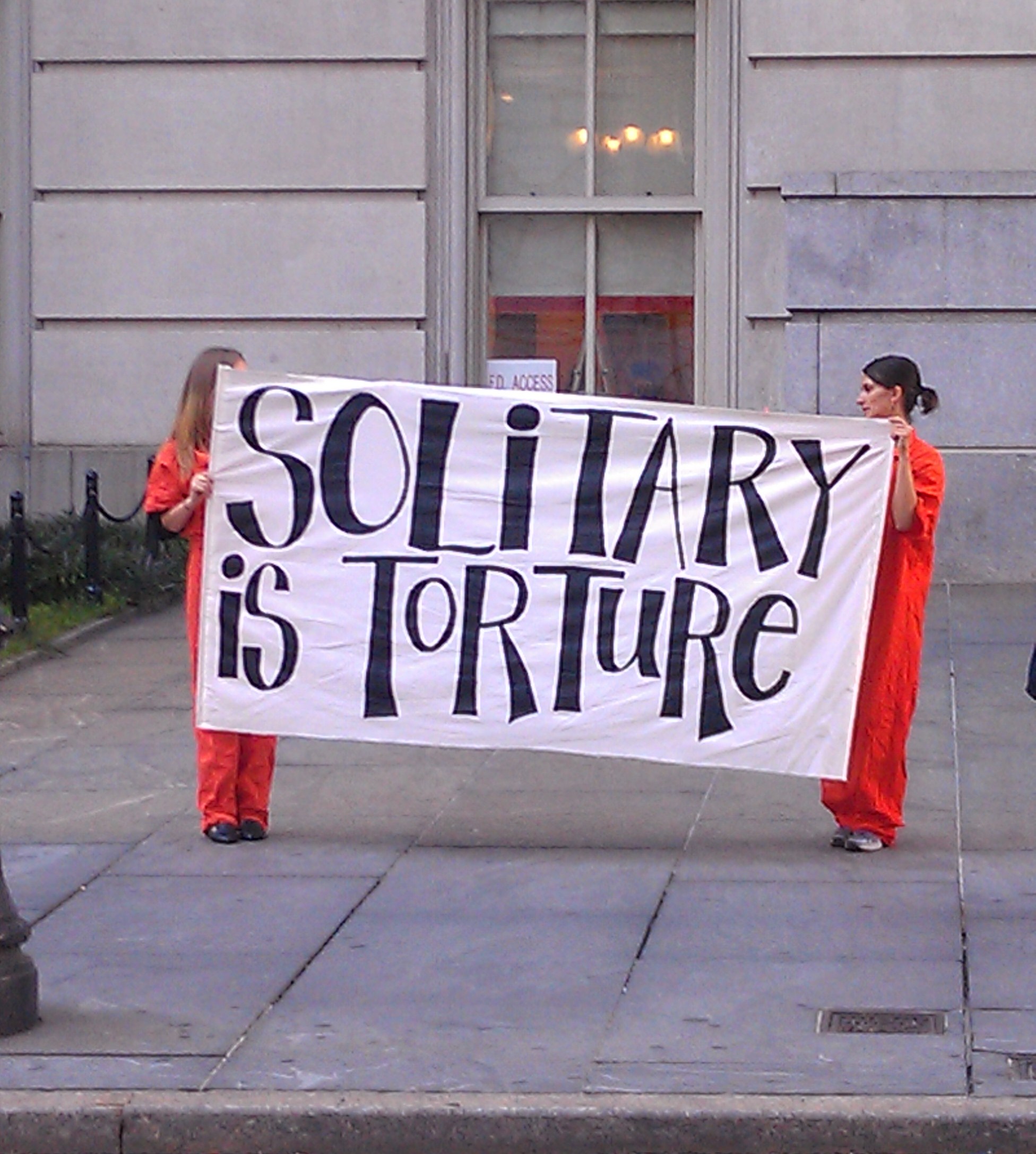
jac demo big 1NEW YORK — Representatives of human rights, civil liberties, and religious organizations will join formerly incarcerated people and family members of those in solitary confinement at several vigils across the state, to protest the routine use of extreme and prolonged isolation in New York’s state prisons and city jails.

The largest vigil, which is part of a longer event highlighting current human rights issues in New York, will take place on Human Rights Day, Tuesday, December 10, from 4 – 5 pm in Lower Manhattan’s Foley Square, within sight of several courthouses and detention centers.

Billed as a “Teach-in and Speak-out,” the vigil will feature advocates from the Campaign for Alternatives to Solitary Confinement (CAIC), including individuals who have been directly affected by the use of solitary confinement. The vigil will conclude with the words of people currently in solitary, read by representatives of the National Religious Campaign Against Torture.

“We want New Yorkers to recognize that there are serious human rights violations going on in their own backyards,” said Five Omar Mualimm-ak of the American Friends Service Committee, a survivor of five years in solitary confinement in New York state prisons and an organizer of the vigil.  “By depriving people of all human contact, solitary confinement causes extreme anguish and permanent psychological damage,” Mualimm-ak continued. “That’s why it has been widely denounced as torture.”

On Long Island, a Human Rights Day vigil will be held on Saturday, December 14, at 12 noon at the Nassau County Jail in East Meadow, also featuring religious leaders, activists, survivors, and family members.  “We know that our children or spouses can be sent to these houses of torture for the slightest infraction,” said Barbara Allan of Long Island’s Prison Families Anonymous. “We know the consequences, and we worry about how this will affect them upon release.”

In Upstate New York, the site of most of the state’s 62 prisons, opponents of solitary will gather for a vigil in Ithaca on Sunday, December 8, at 2 pm in front of Tompkins County Library. The vigil will be followed by a write-a-thon to incarcerated individuals at Tompkins County Workers’ Center, with Amnesty International. The Ithaca Prisoner Justice Network is also holding a letter writing campaign in three local Episcopal churches to urge policy-makers to take action to end isolated confinement.

A vigil will also be held on December 10 at St Lawrence University in Canton. A group of students will spend the day inside chalk outlines of 7 x10-foot cells to call attention to the use of solitary in New York.

According to CAIC, New York’s prison and jails use solitary and other forms of isolated confinement far too broadly and routinely, and for periods of time, namely months and years, that far exceed the 15 day-limit recommended by the UN Special Rapporteur on Torture. New York holds people in 23-hour-a-day isolation at rates significantly above the national average. On any given day, there are at least 4,000 people, disproportionately people of color, in New York State prisons who are in special housing units (SHU) and thousands more locked down in their own cells. In addition, approximately 1,000 people in New York City jails are held in isolation.

Solitary confinement often causes deep and permanent psychological, physical, and social harm for those who endure it, and can have even more dire consequences for the many incarcerated individuals with pre-existing mental health needs or disabilities, and for youth. Prolonged isolation has been shown to be counterproductive as well as inhumane, since it can increase both prison violence and recidivism levels.

“We need a fundamental transformation of how corrections officials understand and respond to problematic behavior,” says Jennifer Parish of the Urban Justice Center, a CAIC member group that helped to spearhead the rallies around the state. “We no longer can allow ineffective, inhumane responses that exacerbate the problems; we want safe, humane, and effective responses that fit in line with our fundamental human values and make things safer for our prisons and our communities.”

Solitary confinement in New York’s state prisons has been challenged not only by advocates, but by UN Special Rapporteur on Torture Juan E. Méndez. In March of 2013, Méndez wrote to the U.S. government, seeking information about the practice of extreme isolation and solitary confinement in New York State prisons and the welfare of three individuals subjected to this treatment.

This week, CAIC sent letters to both U.S. Secretary of State John Kerry and New York Governor Andrew M. Cuomo, urging them to provide the requested information, and to facilitate Mr. Méndez’s access to conduct fact-finding visits to New York prisons and jails. “With Human Rights Day approaching,” the letter reads, “we join in calling on you to take these steps to honor the humanity and dignity of New Yorkers suffering the torture of solitary confinement.”

Survivors of solitary confinement and families of those currently in isolation are available for interview in New York City and on Long Island.

For more information, please contact:

Megan Crowe-Rothstein, 646-602-5665 megan@urbanjustice.org

Five Mualimm-ak, 646-294-8331, endthenewjimcrow@gmail.com.

Scott Paltrowitz, 212-254-5700 spaltrowitz@correctionalassociation.org

NEWS: Roundup of National News on Isolated Confinement, October/November 2013

By Fran Geteles-Shapiro

November 9, 2013

A new report by the New Mexico Center on Law and Poverty (NMCLP) and the ACLU of New Mexico (ACLU-NM) reports on the systems abuses of solitary confinement, including: overuse; isolation of people suffering from serious mental illness; use of prolonged segregation for the mentally ill; and, the lack of transparency and oversight.  Reforms are recommended. http://nmpovertylaw.org/WP-nmclp/wordpress/WP-nmclp/wordpress/wp-content/uploads/2013/10/Solitary_Confinement_Report_FINALsmallpdf.com_.pdf

November 8, 2013

A reporter discusses his visit to the Ad Seg cellblock of a prison in Maine where the typical number of prisoners in isolation has been reduced by more than 50%.  He points out that those who remain in solitary are still in grim ugly, super harsh conditions from which there are constant reports of cruelty, inadequate medical care, understaffing, and deliberate mixing of predators and the vulnerable. http://portland.thephoenix.com/news/156318-rare-look-inside-the-maine-state-prisons-‘super/#ixzz2kejcZjsZ

November 6, 2013

A report on Solitary Watch summarizes the findings of the two psychiatrists who were asked by the NYC Board of Corrections to assess whether the city is in compliance with their Mental Health Minimum Standards.  Their highly critical report found that the standards are being violated. After the report was published the BOC voted to begin rulemaking to limit the use of solitary confinement in NYC. http://solitarywatch.com/wp-content/uploads/2013/11/Gilligan-Report.-Final.pdf  http://solitarywatch.com/2013/11/06/reports-condemn-abuse-solitary-confinement-new-york-citys-jails-officials-weigh-future/

The American Public Health Association (APHA) issued a statement against solitary confinement recommending: people with serious mental illnesses and juveniles be excluded from solitary; people in solitary confinement be closely monitored and removed if their physical or mental health deteriorates or necessary health services cannot be provided; alternative means of discipline should be created; isolation for clinical or therapeutic purposes should be permitted only upon the order of a credentialed health care provider; and, individuals isolated for their personal safety must have access to programs, treatment, education, recreation, visitation, and social interactions comparable to that afforded prisoners in the general population. http://www.apha.org/NR/rdonlyres/AEF53EE6-7E3E-4E87-8731- 4D2C5BB2CF2D/0/C2SolitaryConfinement.pdf

November 3, 2013

A new report from the Taskforce on Preserving Medical Professionalism in National Security Detention Centres says that doctors and psychologists working for the US military violated the ethical codes of their profession under instruction from the defense department and the CIA to become involved in the torture and degrading treatment of suspected terrorists.  They were in effect told that their ethical mantra “first, do no harm” did not apply, because they were not treating people who were ill. The taskforce wants rules to ensure doctors and psychiatrists working for the military are prohibited from taking part in interrogation, sharing information from detainees’ medical records with interrogators, or participating in force-feeding, and they should be required to report abuse of detainees. http://www.theguardian.com/world/2013/nov/04/cia-doctors-torture-suspected-terrorists-9-11

November 2, 2013

A summary of quantitative data available about who is held in segregated confinement in our nation’s prisons and jails suggests that in many states the harsh conditions of solitary confinement are probably disproportionately affecting people of color. http://solitarywatch.com/2013/11/02/prison-segregation-racial-disparities/

October 31, 2013

The ACLU of Montana won an agreement regarding access to outdoor exercise for prisoners in a jail.  The jail in this case had outdoor recreation for two of its housing units holding adult males, but not for the housing units holding ad seg, female populations and juveniles.  The jail has agreed to build recreation areas onto these housing units and provide daily access. http://aclumontana.org/images/stories/documents/litigation/chiefgoesoutsettlement102013.pdf

October 29, 2013

A former prison official and an advocate for the rights of incarcerated people together suggest reforms in the use of solitary confinement in CA and NY:  no more applying it to minors or for nonviolent offenses or using it for crowd control; allowing opportunity to read, receive visits, make phone calls, and have other forms of human contact and stimulation; shorter periods of isolation; periodic review; alternative sanctions; and, the use of “conditional discharges” for first-time nonviolent offenders who “clean up their records.” http://www.timesunion.com/opinion/article/Reform-prison-isolation-4933317.php

October 27, 2013

North Carolina Prisoner Legal Services has filed a lawsuit on behalf of a man diagnosed with paranoid schizophrenia who has a history of childhood sexual abuse alleging that he was abused at North Carolina’s Central Prison by guards who repeatedly doused him with excessively high doses of pepper spray, causing him great pain. The suit raises questions about the treatment of individuals in solitary confinement.  The plaintiff in the case spent years cycling between cells in the prison mental ward and solitary confinement – often in response to behaviors that are primary symptoms of his illness. http://charlotte.cbslocal.com/2013/10/27/suit-mentally-ill-nc-inmate-often-pepper-sprayed/

October 23, 2013

At the urging of Colorado’s ACLU’s chapter, a senator is sponsoring a bill to find alternatives to the use of so-called administrative segregation for prisoners who have been diagnosed with serious psychological disorders. Citing the recent killing of a state corrections official by a man released directly from solitary confinement, he says, “We are doing the least safe thing.”
http://www.coloradoindependent.com/144572/lawmaker-will-seek-to-abolish-solitary-confinement-for-mentally-ill-prisoners

October 22, 2013

An article for the ACLU discusses the importance of the UN’s efforts to update their Standard Minimum Rules for the Treatment of Prisoners (SMRs) with particular focus on the need for sufficient protections against lengthy solitary confinement. https://www.aclu.org/blog/prisoners-rights/historic-opportunity-advance-international-norms-prisoners-rights

October 19, 2013

Russell Shoatz’s lawyers submitted a communication to Juan E. Mendez, the United Nations’ special rapporteur on torture urging him to inquire into why a “father, grandfather and great grandfather” is being held in extreme isolation despite having a near-perfect disciplinary record for over 20 years.  One of the attorneys expressed the hope that an investigation by the office of the special rapporteur will bring an end to indefinite isolation. http://www.ipsnews.net/2013/10/the-u-s-s-64-square-foot-torture-chambers/?utm_content=bufferbdf02&utm_source=buffer&utm_medium=twitter&utm_campaign=Buffer

October 18, 2013

A man in prison in Illinois, who was arrested in the lead up to Occupy Chicago, has been in solitary confinement since July for possessing anarchist literature. He isn’t accused of plotting to harm guards or other incarcerated people, but his political beliefs alone are described as a threat to the safety and security of persons or the facility. http://www.vice.com/read/prisoner-sent-to-solitary-for-copious-amounts-of-anarchist-publications

Juan Méndez, the UN Special Rapporteur on torture, has requested access to California prisons to investigate the use of solitary confinement and ensure that the rights of prisoners’ are being protected. He said he wants access to any part of any prison he chooses and the freedom to speak with any incarcerated individuals of his choosing.” http://www.latimes.com/local/political/la-me-ff-un-torture-investigator-seeks-access-to-california-prisons-20131018,0,15846.story

Amidst growing criticism of its abundant use of solitary confinement, the federal Bureau of Prisons has initiated an audit to review its “restricted housing operations.”  But, since the audit has been contracted out to a nonprofit best known as a military think tank and will be conducted largely by former corrections officials, it seems unlikely to bring any dramatic change to the lives of the people held in isolation in the federal prison system. Meanwhile, the federal government has completed purchase of a prison meant to house still more isolation cells. http://solitarywatch.com/2013/10/18/fire-federal-bureau-prisons-audits-use-solitary-confinement-buys-new-supermax-prison/

October 17, 2013

Questions are being raised about whether the extensive use of Secure Housing Units in CA have reduced gang membership or violence in the prisons.  Meanwhile prison officials have begun to provide a new “step-down” program which might reintroduce individuals into the general population gradually, over four years. http://kvpr.org/post/do-californias-security-housing-units-reduce-prison-violence

October 16, 2013

Lawyers for individuals who have been condemned to death in CA are asking a U.S. District Judge to require psychiatric hospitalization for the most mentally ill people on death row and to ban the use of pepper spray as a means of controlling them.  They showed videos of individuals being drenched with burning pepper spray and dragged from their cells for refusing medication or psychiatric evaluation.  Prison officials argue their care is adequate and no one was hurt in the incidents depicted in the videos. http://www.latimes.com/local/political/la-me-ff-prison-lawyers-challenge-care-for-californias-condemned-20131016,0,5753340.story#axzz2iwsid0gN

Anthony Graves, who spent 18 years in prison, 12 of them in solitary confinement on death row in Texas, used funds he received from the state for his wrongful conviction to set up a law school scholarship in the name of Nicole Cásarez, the Houston attorney and journalism professor who fought for eight years to secure his freedom.  He also used some of the money to start a foundation to help at-risk children with incarcerated parents. http://www.texasmonthly.com/story/anthony-graves-establishes-scholarship#.Ul7ygaqS5uQ.twitter

October 14, 2013

The US military has announced the end of the six-month mass hunger strike among detainees at Guantánamo Bay, but human rights groups argue that such proclamations are disingenuous as at least 16 inmates are still force-fed daily, and two are in hospital. Also, several of the men and their lawyers have reported that hunger strike participants were coerced into ending their participation in the strike by harsh treatment including isolated confinement, extreme humiliation including forced nudity, temperature manipulation cell searches timed to disrupt their sleep, and denial of their belongings including necessities like eyeglasses.  A particular victim of this harsh treatment was Shaker Aamer, though Britain’s Prime Minister is actively trying to have him released and returned to the UK. http://www.theguardian.com/world/2013/oct/12/us-military-stormed-hunger-striker-cell

September 30, 2013

An attorney with the ACLU of VA criticizes recent efforts of the corrections department for failing to include the needs of individuals with serious mental disabilities. She notes the lack of treatment programs. She also discusses the difficulty mentally ill individuals would have adhering to the new step-down program designed to enable people in solitary to earn a return to the general population, pointing out that they are thus likely to remain in solitary indefinitely. http://www.roanoke.com/opinion/commentary/2252289-12/mentally-ill-prisoners-in-solitary-confinement-left-behind.html

September 26, 2013

CCR attorneys for 10 men in solitary confinement at Pelican Bay State Prison in Ashker v. Brown, have asked the courts to make the lawsuit a class-action-suit because hundreds more are suffering in the same appalling conditions and any remedies should apply to everyone affected. The lawsuit alleges that prolonged solitary confinement violates Eighth Amendment prohibitions against cruel and unusual punishment, and that the absence of meaningful review for SHU placement violates the prisoners’ right to due process. http://ccrjustice.org/newsroom/press-releases/hundreds-of-california-prisoners-isolation-should-be-covered-class-action%2C-attorneys-argue-court

Speaking of the recent ending to the hunger strike at Pelican Bay Prison, one of the self described “principal prisoner representatives” said the strike may resume if deemed necessary.  One factor in the suspension of the hunger strike was the promise of hearings at the CA state assembly in Sacramento. The representative said he does not share the optimism of outside supporters who hailed a public relations victory when the strike ended, but believes “we have to wait and see what the politicians come up with.” http://www.theguardian.com/world/2013/sep/27/california-prison-hunger-strike-todd-ashker

A strong statement about children in solitary confinement, including the critically relevant issue of children tried as adults. http://www.exposingthetruth.co/children-in-solitary-confinement/?utm_source=feedburner&utm_campaign=Feed:+ExposingTheTruthco+%28Exposing+The+Truth.co%29&utm_content=bufferefd8b&utm_medium=twitter#axzz2gCliceb0

As part of a federal class-action lawsuit brought last year by the ACLU of Illinois, three court-appointed experts found that Illinois’ youth prison system is violating the constitutional rights of young people in their custody by failing to provide adequate mental health care and education and by unnecessarily keeping youths in solitary confinement of “harsh and of substandard quality.” They pointed out the inadequate staffing, including the fact that there is not a single psychiatrist specializing in children and adolescents.  Negotiations to fix the problems are currently in progress. http://www.chicagotribune.com/news/local/ct-met-illinois-youth-prison-20130926,0,4795774.story

September 23, 2013

A 61-year-old man with a history of violence and murder which occurred many years ago while he was in prison, who has since been in solitary confinement for 30 years under a “no human contact” order, has challenged this “cruel and unusual treatment.” Although mental health experts have diagnosed severe emotional and cognitive effects, a U.S. District Court supported the Bureau of Prison’s assertions that he has been unharmed by this extreme isolation because it has not deprived him of life’s basic necessities. The case is now before the U.S. Tenth Circuit Court of Appeals. http://www.coloradoindependent.com/144083/denver-judge-to-weigh-how-much-is-too-much-solitary-confinement

September 21, 2013

The Texas Tribune analyzed data from violent-incident reports from 99 state prisons filed from 2006 to 2012, and found: far more reports of violence at facilities housing high numbers of mentally ill and violent incarcerated people than at other prisons; reports of violent episodes are more prevalent at smaller institutions that house only psychiatric patients; and, there are more incidents of officers using force at these facilities. Advocates the numbers show that the state’s approach to incarcerating the mentally ill is not working, but criminal justice department officials argue that the state facilities are safe, and programs aimed at helping mentally ill individuals are working. http://www.nytimes.com/2013/09/22/health/a-tie-to-mental-illness-in-the-violence-behind-bars.html?utm_content=buffer92df3&utm_source=buffer&utm_medium=twitter&utm_campaign=Buffer&_r=0

September 16, 2013

Albert Woodfox of the Angola 3, who has been in solitary confinement for over 40 years, has gone to court requesting a restraining order against the state of LA to stop strip and cavity searches, which he says occur whenever he leaves his cell – i.e. “as often as six times a day.”  After the Angola 3 sued against such searches in the late 70s, a consent decree was agreed to by the parties which held that they violated the rights of these men and must be curtailed or ceased.  However, when the judge responsible for the decree died recently, the searches were re-instated, thus requiring the return to court. http://www.theatlantic.com/national/archive/2013/09/a-handwritten-letter-the-prison-system-doesnt-want-you-to-see/279751/


VOICES: Solitary Confinement’s Invisible Scars

By Five Omar Mualimm-ak. Reprinted from The Guardian.

nys doccsAs kids, many of us imagine having superpowers. An avid comic book reader, I often imagined being invisible. I never thought I would actually experience it, but I did.

It wasn’t in a parallel universe – although it often felt that way – but right here in the Empire State, my home. While serving time in New York’s prisons, I spent 2,054 days in solitary and other forms of isolated confinement, out of sight and invisible to other human beings – and eventually, even to myself.

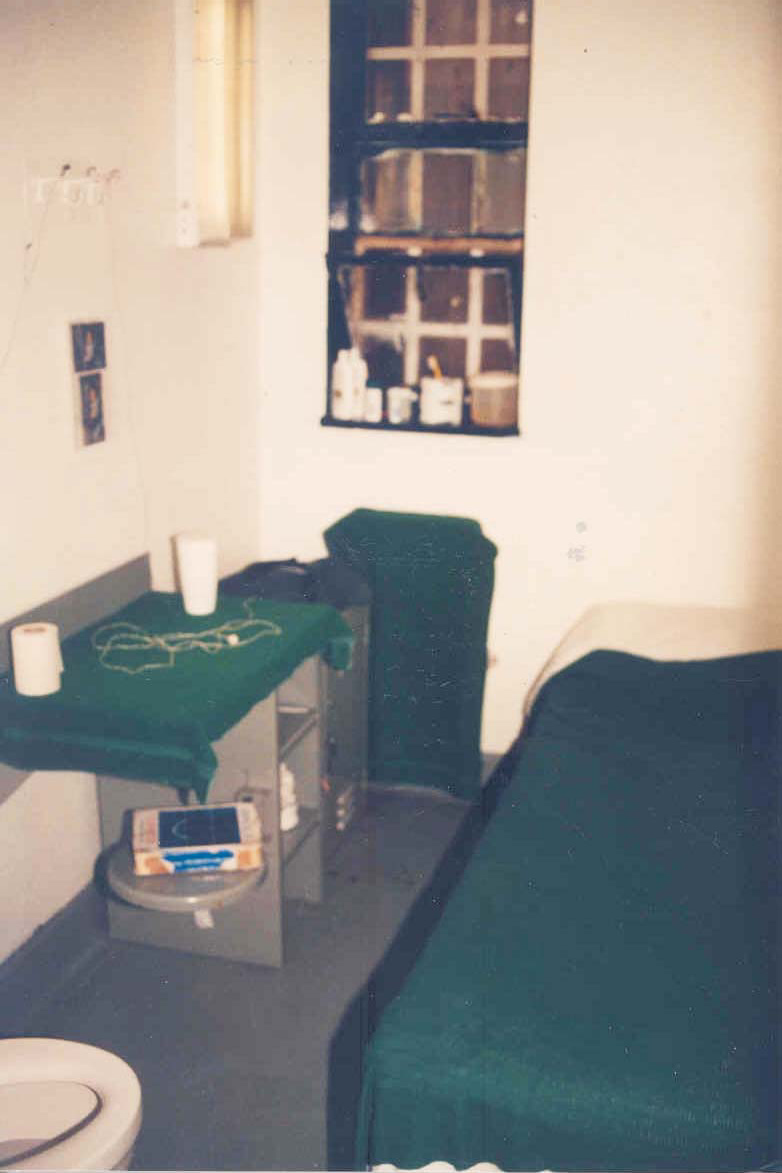
After only a short time in solitary, I felt all of my senses begin to diminish. There was nothing to see but gray walls. In New York’s so-called special housing units, or SHUs, most cells have solid steel doors, and many do not have windows. You cannot even tape up pictures or photographs; they must be kept in an envelope. To fight the blankness, I counted bricks and measured the walls. I stared obsessively at the bolts on the door to my cell.

There was nothing to hear except empty, echoing voices from other parts of the prison. I was so lonely that I hallucinated words coming out of the wind. They sounded like whispers. Sometimes, I smelled the paint on the wall, but more often, I just smelled myself, revolted by my own scent.

There was no touch. My food was pushed through a slot. Doors were activated by buzzers, even the one that led to a literal cage directly outside of my cell for one hour per day of “recreation”.

Even time had no meaning in the SHU. The lights were kept on for 24 hours. I often found myself wondering if an event I was recollecting had happened that morning or days before. I talked to myself. I began to get scared that the guards would come in and kill me and leave me hanging in the cell. Who would know if something happened to me? Just as I was invisible, so was the space I inhabited.

The very essence of life, I came to learn during those seemingly endless days, is human contact, and the affirmation of existence that comes with it. Losing that contact, you lose your sense of identity. You become nothing.

Everyone knows that prison is supposed to take away your freedom. But solitary doesn’t just confine your body; it kills your soul.

Yet neither a judge nor a jury of my peers handed down this sentence to me. Each of the tormented 23 hours per day that I spent in a bathroom-sized room, without any contact with the outside world, was determined by prison staff.

[Read more…]

NEWS: Reports Condemn Solitary Confinement in New York City’s Jails, As Officials Weigh Its Future

By Marlies Talay. Reprinted from Solitary Watch.

rikers wireTwo recent reports provide a scathing picture of how solitary confinement is employed as a routine disciplinary measure on Rikers Island and in other city jails. The reports are particularly critical of the use of extreme isolation and deprivation on individuals with psychological disabilities, including mentally ill teenagers.

The two reports were prepared for the Board of Correction (BOC), which functions as the oversight agency for the New York City jail system, ensuring that all city correctional facilities comply with minimum regulations of care. In recent months, under pressure from local activists, the BOC has been reconsidering the liberal use of solitary confinement in the city’s jails, and conducting fact-finding on the subject.

The first of two reports commissioned by the BOC was released in September 2013. Dr. James Gilligan and Dr. Bandy Lee authored the report, addressing the use of solitary confinement in the city’s jails.  This past June, Dr. Gilligan and Dr. Lee were asked to assess whether the city’s jails were in compliance with the current Mental Health Minimum Standards set forth by the Board of Correction.

On Rikers Island, which houses more than 10,000 of the 13,000 women, men and children in the city’s jails, 1 in every 10 people is in isolated confinement at any time.  Many are placed there for nonviolent offenses at the discretion of corrections officers.  This distinguishes New York as a city with one of the highest rates of prison isolation in the country–about double the national average.

The report’s findings are a resounding criticism of the current use of punitive segregation, and point both to violations of the Mental Health Minimum Standards as well as to practices within the jail system that are harmful to those who suffer from mental illness. The report’s authors point to snapshot data in which the number of people with mental illness in solitary confinement is almost double the number of those with mental illness in the jail population generally. The authors conclude that mentally ill people in the jail system are being disproportionately placed in solitary confinement.

The report also claims that the nation’s prisons and jails have become “de facto mental hospitals,” pointing to the fact that roughly 95% of people with mental illness who are currently institutionalized are in correctional facilities, while only 5% are in mental hospitals.

The Mental Health Minimum Standards mandate that mental healthcare be provided in a setting that is conducive to care and treatment. The report contends that prolonged use of solitary confinement for mentally ill people violates these Standards, because it has been used punitively, to create a stressful environment and to remove social contact, rather than to provide therapeutic services.

Moreover, the report holds that the Standards should be amended to emphasize that those with mental illness should not be held in segregation.  As the report states, “The goal of mental health treatment (and also of correctional practice) should be to do everything possible to foster, enhance and encourage the inmates’ ability to…behave in constructive and non-violent ways after they have returned to the community from jail.”

The city responded to the report with a point-by-point rejection of its findings, claiming that the principal conclusions drawn by Drs. Gilligan and Lee were based on an erroneous legal interpretation of the Mental Health Minimum Standards and that the report’s conclusions and further recommendations were unsupported by sufficient evidence. This response was put forth by a multiple agencies, including the Office of the Mayor, the Department of Corrections and the Department of Health and Mental Hygiene.

Drs. Gilligan and Lee responded in turn, claiming that a strictly legal interpretation ignored the changing conditions of the current prison system as well as a misunderstanding of human psychology and behavior.  In order to reach a true understanding of the harm caused by punitive segregation, the authors say, we need to take into account the psychological effects of isolation, as well as the recent influx of people with mental illness into our prisons and jails.

One week after Drs. Gilligan and Lee published their report, the BOC voted unanimously to begin rulemaking to limit the use of solitary confinement in New York City.

These events follow a meeting held in June, in which the Board of Correction voted against limiting solitary confinement in the city’s jails, rejecting a petition put forth by the grassroots group known as the Jails Action Committee (JAC). The petition, if it had been accepted, would have limited solitary confinement as a last resort punishment for violent behavior only, and banned it entirely for children, young adults, and those with mental and physical disabilities.

BOC member Dr. Robert Cohen, a Manhattan physician and expert on prison health and mental health care, vocally supported JAC’s petition. At this June meeting, he called the use of solitary “dangerous,” especially for people with mental illness and adolescents, who are confined in punitive segregation at particularly high rates.  “During the past three years,” he pointed out, ”the percentage of prisoners languishing in solitary confinement has increased dramatically, without benefit in terms of decreased violence or increased safety on Rikers Island,” either for corrections officers or the prisoners themselves.

Dr. Cohen’s statement rings especially true after the release of the most recent BOC report in October, one month after the first report was published. Providing new information about the suffering of mentally ill youth placed in solitary confinement, the report describes the experiences of three adolescent boys at Rikers Island, each held in punitive segregation for more than 200 days, each suffering from mental illness. Youth and adolescents are among the most vulnerable populations in New York’s jail system; the report makes clear, however, that segregating mentally ill youth as a form of punishment is both negligent and dangerous.  The city has yet to respond to this latest criticism of solitary confinement.

The consequences of time spent in solitary confinement are lengthy and harmful, Cohen and other experts say; they include negative effects on mental health, including severe depression, anxiety, hallucinations, paranoia, insomnia, and panic attacks. Furthermore, studies have shown that common patterns of depression, anxiety, anger, and suicidal thoughts often leave individuals more prone to unstable and violent behavior, which can in turn lead to higher rates of recidivism.

NEWS: Roundup of National News on Isolated Confinement, September/October 2013

Compiled by the CAIC Research Committee.

October 14, 2013
The Nation magazine has begun a monthly series of articles to provide a systematic look at the pattern of rights abuses in the domestic “war on terror.”  This first article looks at American’s blindness to the abusive treatment of ‘terror’ suspects on US soil including the use of prolonged pretrial solitary confinement and restricted communication. The article also notes the use of solitary confinement for many groups of political activists.
http://www.thenation.com/article/176354/guantanamo-new-york-city?page=0,1#

October 12, 2013
A tribute to Herman Wallace has been put in the US Congressional Record by several congressmen, who promise to dedicate their future efforts to “ensuring that no one anywhere in the United States is subjected to the unjust and inhumane treatment that he has endured.”
https://www.indybay.org/newsitems/2013/10/12/18744783.php

October 9, 2013
Legislative hearings on Solitary Confinement — with testimony from expert panelists including the ACLU, legal scholars, incarcerated persons’ loved ones, and formerly incarcerated persons — were held today in CA in response to the recent hunger strike there.  Some Senators promised that these “public discussions will lead to legislation.”
https://twitter.com/search?q=%23CAHungerStrike&src=hash

October 8, 2013
The ACLU is making a big push in its campaign to urge the Department of Justice to ban the use of solitary for youth in their care, beginning with a u-tube video that exposes the impact of solitary confinement on youth. In Colorado, the ACLU is also showing two films dealing with solitary confinement, Out of Sight, Out of Mind (based on one of the cases highlighted in their recent report on the Colorado Department of Corrections’ continued warehousing of mentally ill incarcerated persons in solitary confinement) and The Worst of the Worst
https://www.youtube.com/watch?feature=player_embedded&v=VvzYnjndcEk&noredirect=1
http://aclu-co.org/sites/default/files/imce/ACLU-CO%20Report%20on%20Solitary%20Confinement_2.pdf

October 7, 2013
The United Nations Special Rapporteur on torture, Juan E. Méndez, today called on the United States to immediately end the indefinite solitary confinement imposed on Albert Woodfox since 1972 which, he says, clearly amounts to torture and goes far beyond what is acceptable under international human rights law.. http://www.unog.ch/unog/website/news_media.nsf/(httpPages)/4581FCB3B892AD71C1257BFD0042D0DE?OpenDocument#sthash.rxAwohz9.dpuf

October 4, 2013
After 42 Years in Solitary, Herman Wallace Died a Free Man after a court order overturned his conviction, granting full habeas relief and ordering him a new trial due to an improperly chosen grand jury.  The Judge further ordered Mr. Wallace’s immediate release.
https://www.aclu.org/blog/prisoners-rights/after-42-years-solitary-herman-wallace-dies-free-man
http://solitarywatch.com/2013/10/01/41-years-solitary-dying-herman-wallace-conviction-overturned/
https://docs.google.com/file/d/0B8bT8f-N8gQvR09ma0RzbXZvZE0/edit?usp=sharing

In a lawsuit contending that incarcerated people with mental illness are subject to brutal and inhumane treatment by the California prison system, videos were shown of California prison guards pumping pepper spray into the cells of incarcerated persons – some of whom were naked and screaming, all of whom suffer from mental illness – and then forcibly extracting them from their cells.
http://solitarywatch.com/2013/10/04/lawsuit-alleges-guard-brutality-prisoners-mental-illness-california-state-prisons/

October 2, 2013
Lawyers for Dzhokhar Tsarnaev, the accused Boston Marathon bomber, asked a federal judge to ease special restrictions that have been placed on him in prison, saying they have unduly left him in harsh isolation while preventing proper communication with his family and his legal team.  They argue that, since his arrest, there has been no evidence that he poses a further threat of violence or to national security. And they say their access to him is vital to build a case against the death penalty. http://www.bostonglobe.com/metro/2013/10/02/dzhokhar-tsarnaev-prison-restrictions-should-eased-attorneys-argue/j14fAHkT50moW41NbxDDGM/story.html

Prison officials have finally agreed to transfer a floridly psychotic man from ADX-Florence to the federal mental health prison at Springfield, Missouri. His mother had fought for him to get treatment for 5 years, but nothing was done.  The authorities kept saying the man was just “playing with them.” http://www.theatlantic.com/national/archive/2013/10/prison-officials-finally-agree-to-transfer-floridly-psychotic-inmate/280186/

September 30, 2013
An article in Prehospital and Disaster Medicine, a publication of the World Association for Disaster and Emergency Medicine (WADEM), says that Physicians and other licensed health professionals who are force-feeding hunger strikers at GTMO, are violating the medical ethics they swore to uphold and are complicit in torture.  The authors urge the licenses of health professionals who participate in force-feeding be revoked.  They also call for the medical profession to demand changes in military medical management protocols and stronger protections for military health professionals who protest unethical orders.
http://www.prweb.com/printer/11175870.htm

September 26, 2013
A federal judge has said she is likely to allow a lawsuit alleging that solitary confinement conditions at Pelican Bay State Prison amount to psychological torture, to be expanded from the original 10 plaintiffs to include about 1,100 people who are now held in indefinite isolation. But she has not yet issued a definite decision.  At issue is the question of who would be included in a class action suit, since the authorities have changed some rules and keep moving the incarcerated individuals around.
http://www.latimes.com/local/political/la-me-ff-solitary-confinement-case-set-to-expand-20130926,0,1473630.story

NEWS: Roundup of National News on Isolated Confinement, July/August 2013

Compiled by the CAIC Research Committee.

August 13, 2013

An article in a Pakistani newspaper, asks the question of whether force feeding is ‘torture’ or humane treatment. While a senior medical advisor at Guantanamo insists that it is done to save lives, he acknowledges that quite a few of the hunger strikers have been taken to the hospital to be resuscitated. http://www.nation.com.pk/pakistan-news-newspaper-daily-english-online/international/13-Aug-2013/force-fed-torture-or-humane-treatment-at-guantanamo

August 12, 2013

In Britain, a former MI6 officer is on hunger strike in support of Guantanamo Bay prisoner Shaker Aamer.  He said he is motivated by shame at his former employer which he said supported policies including torture and detention without trial. http://www.independent.co.uk/news/uk/crime/former-mi6-officer-on-hunger-strike-over-guantanamo-inmate-8758213.html

August 8, 2013

The mediation team working on behalf of the CA hunger strikers was able to speak to representatives of the prisoners at Pelican Bay. They report that, despite increasingly abusive treatment, the prisoners remain steadfast in continuing their protest, and stated clearly that “this peaceful protest is not about them—it is about making real, fundamental changes to an incredibly unjust system.” The representatives also said that they are incredibly inspired by all the support they’ve received. http://prisonerhungerstrikesolidarity.wordpress.com/2013/08/08/mediators-talk-with-prisoners-as-hunger-strike-reaches-one-month-mark-situation-remain-critical-negotiations-crucial/

Pat Nolan, the conservative evangelist and former prisoner who is now Vice President of Prison Fellowship, the nation’s largest prison reform group, says, “Putting someone in solitary is a fate worse than death … nothing, other than murdering a guard, can possibly justify putting them in these conditions that drive them mad.” http://solitarywatch.com/2013/08/08/draft-pat-nolans-evangelical-prison-reform/

August 6, 2013

Jeffrey Beard, the head of California’s Dept. of Corrections and Rehabilitation, writes in an Op-Ed, that the hunger strike is a gang power play by convicted murderers who are putting lives at risk to advance their own agenda of violence. He also claims that many of those participating in the hunger strike are under extreme pressure to do so from violent prison gangs. Solitary Watch raises some questions about his statements. http://www.latimes.com/news/opinion/commentary/la-oe-beard-prison-hunger-strike-20130806,0,636927.story

http://solitarywatch.com/2013/08/06/california-hunger-strike-approaches-one-month/

August 3, 2013

Advocates for prisoners on hunger strike to protest California’s solitary confinement program met with the state prisons chief as they pushed for an end to practices they say are inhumane.  A corrections spokesperson said the agency will review the group’s policy suggestions. http://www.thereporter.com/ci_23789389/california-prisons-chief-meets-inmate-advocates?source=most_viewed&utm_content=buffer32534&utm_source=buffer&utm_medium=twitter&utm_campaign=Buffer

August 2, 2013

The California Assembly is considering a bill which would impose strict limits on the solitary confinement of youth.  The bill was already passed the Senate. http://legiscan.com/CA/bill/SB61/2013

July 31, 2013

The group of 9 young, undocumented immigrants originally brought to this country as children have been jailed by Homeland Security after they walked from the Mexican side of the border in Nogales to the U.S. immigration offices, where they sought to re-enter the U.S. legally.  Currently 6 of them are in solitary confinement as punishment for the hunger strike they undertook in protest against the denial of telephone access to their lawyers and family. http://readersupportednews.org/opinion2/277-75/18675-focus-us-detains-undocumented-aliens-in-solitary-confinement

July 23, 2013

The ACLU of Colorado issues Out of Sight, Out of Mind: Colorado’s continued warehousing of mentally ill prisoners in solitary confinement, a report detailing the findings of a study which showed that the percentage of Colorado prisoners in solitary confinement who are classified as mentally ill has risen. Many of the seriously mentally ill prisoners had been held in isolation for longer than one year, and some for longer than four years.  They recommend: barring mentally ill prisoners from extended periods of isolation; involvement of mental health staff in disciplinary decisions; extended out of cell time; and eliminating the shortage of mental health staff. http://aclu-co.org/sites/default/files/imce/ACLU-CO%20Report%20on%20Solitary%20Confinement.pdf

NEWS: New York Promised Help for Mentally Ill in Prison – But Still Sticks Many in Solitary

By Christie Thompson. Excerpted from Pro Publica.

ht_amir_hall_390x260When Amir Hall entered New York state prison for a parole violation in November 2009, he came with a long list of psychological problems. Hall arrived at the prison from a state psychiatric hospital, after he had tried to suffocate himself. Hospital staff diagnosed Hall with serious depression.  

In Mid-State prison, Hall was in and out of solitary confinement for fighting with other inmates and other rule violations. After throwing Kool-Aid at an officer, he was sentenced to seven months in solitary at Great Meadow Correctional Facility, a maximum-security prison in upstate New York.

Hall did not want to be moved. When his mother and grandmother visited him that spring, Hall warned them: If he didn’t get out of prison soon, he would not be coming home.

A grainy tape of Hall’s transfer on June 18, 2010, shows prison guards spraying chemicals into his cell, forcing him to come out. He barely says a word as he is made to strip, shower, bend over and cough. His head drops, his shoulders slump. His face is blank and expressionless. He stares at his hands, except for a few furtive glances at the silent guards wearing gas masks and riot gear.

“There was somebody who looked defeated, like the life was beat out of him,” said his sister Shaleah Hall. “I don’t know who that person was. The person in that video was not my brother.”

Multiple studies have shown that isolation can damage inmates’ minds, particularly those already struggling with mental illness. In recent years, New York state has led the way in implementing policies to protect troubled inmates from the trauma of solitary confinement.

A 2007 federal court order required New York to provide inmates with “serious” mental illness more treatment while in solitary. And a follow-up law enacted in 2011 all but bans such inmates from being put there altogether.

But something odd has happened: Since protections were first added, the number of inmates diagnosed with severe mental illness has dropped. The number of inmates diagnosed with “serious” mental illness is down 33 percent since 2007, compared to a 13 percent decrease in the state’s prison population.

A larger portion of inmates flagged for mental issues are now being given more modest diagnoses, such as adjustment disorders or minor mood disorders.

It’s unclear what exactly is driving the drop in “serious” diagnoses. But “whenever you draw a magic line, and somebody gets all these rights above it and none below it,” said Jack Beck, director of the Prison Visiting Project for the nonprofit Correctional Association of New York, “you create an incentive to push people below.” The association was one of a coalition of organizations that called for the change in policy.

The New York Office of Mental Health says the decrease reflects improvements to the screening process. Efforts to base diagnoses on firmer evidence “has resulted in somewhat fewer, but better-substantiated diagnoses” of serious mental illness, said a spokesman for the office in an emailed statement.

In Hall’s case, prison mental health staff never labeled his problems as “serious.”

Instead, they repeatedly downgraded his diagnosis. After three months in solitary — during which Hall was put on suicide watch twice — they changed his status to a level for inmates who have experienced “at least six months of psychiatric stability.”

Two weeks after his diagnosis was downgraded, and two days after he was transferred to solitary at Great Meadow, guards found Hall in his cell hanging from a bed sheet…

Read the full article here.

EVENTS: Today in NYC! Rally in Solidarity with California Prison Hunger Strikers

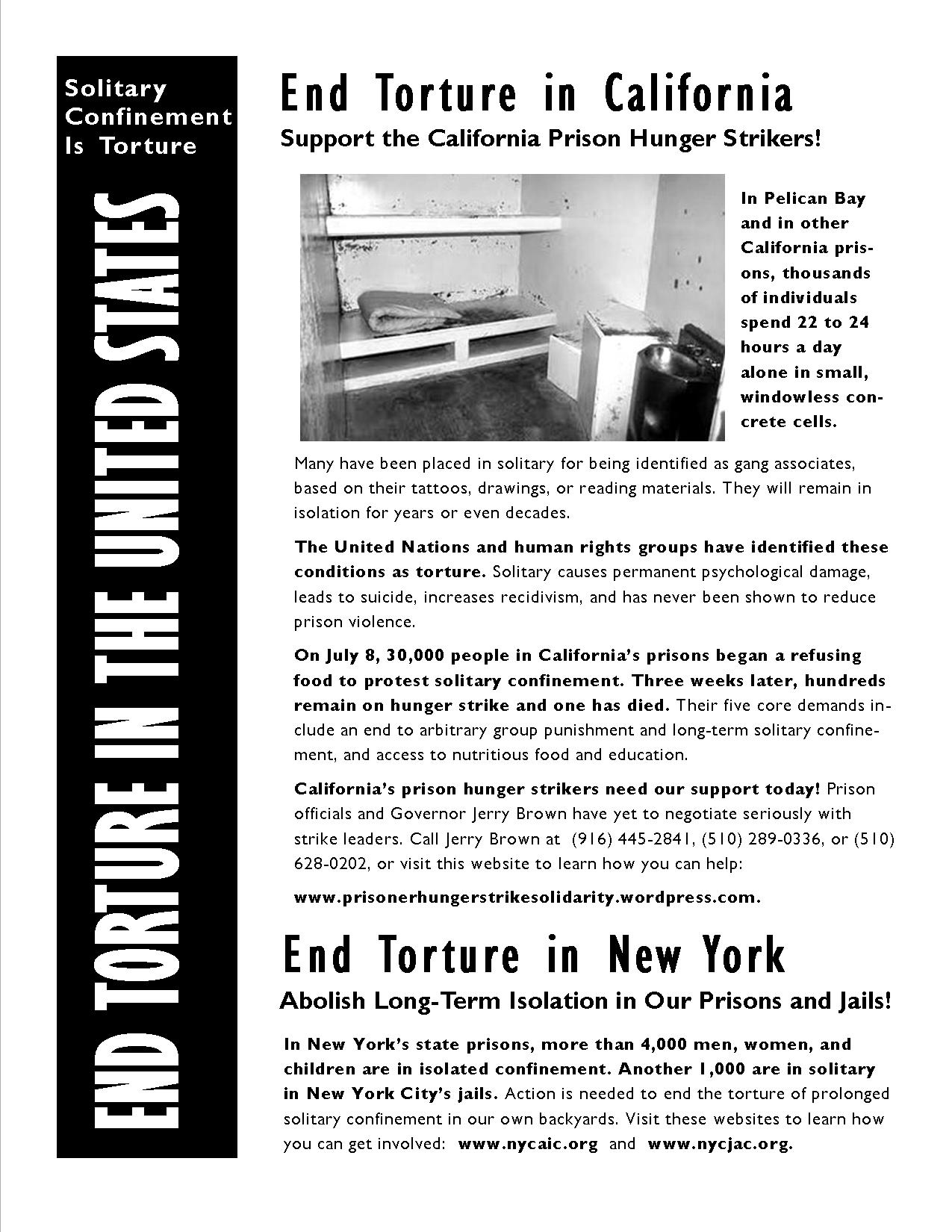
As part of an International Day of Action, members of the New York Campaign for Alternatives to Solitary Confinement, New York City Jails Action Coalition, and concerned community members will rally this afternoon to End Torture in the United States. We will voice our support for the hundreds of individuals still on hunger strike against solitary confinement in California prisons, and press for an end to prolonged isolation in New York’s prisons and jails.

When: Wednesday, July 31, 4:30 to 6:30 pm

Where: 163 West 125th Street (at Adam Clayton Powell Blvd.), in front of the New York State Office Building

  • Bring a poster!
  • Bring friends!
  • Print out the following handout and share it with people in your community: flyer CA NY
  •  Read the full 5 Demands at http://prisoner​hungerstrikesol​idarity.wordpre​ss.com/the-pris​oners-demands-2​/.
  • Call California Governor Jerry Brown at (916) 445-2841, (510) 289-0336, or (510) 628-0202 to demand that he negotiate seriously with the strike leaders.
  • Visit this website to learn how you can help: www.prisonerhun​gerstrikesolida​rity.wordpress.​com.
  • Hang a sign out a visible window stating you are in solidarity with the Hunger Strike and the days of the strike. Today, Tuesday 7/30 is Day 23!
  • Join the New York City Jails Action Coalition www.nycjac.org and the Campaign for Alternatives to Isolated Confinement www.nycaic.org to fight to end torture in our own state!

flyer CA NY

NEWS: New York Activists Launch Fast Against Solitary Confinement in Solidarity with California Prison Hunger Strikers

Press Release from the Campaign for Alternatives to Isolated Confinement and Jails Action Coalition.

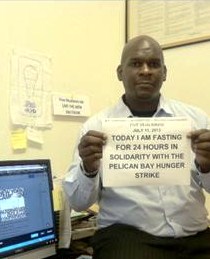
photo fiveNEW YORK, July 13 — Dozens of activists in New York have pledged to fast to express their solidarity with the thousands who are on hunger strike at Pelican Bay and other California prisons. The “rolling fast,” in which each person fasts for one day, began on July 8, on the same day as the California hunger strike, and organizers say it will go on as long as the prison hunger strike continues.

Those who have pledged to fast include survivors of solitary confinement, family members of people held in solitary, advocates, lawyers, mental health practitioners, clergy, and concerned community members. They belong to two local campaigns that oppose the widespread use of solitary confinement in New York’s prison and jails: the Campaign for Alternatives to Isolated Confinement (CAIC) and the New York City Jails Action Coalition (JAC).

“It is important for those of us in New York organizing around solitary confinement in our jails and prisons to support all people who are fighting to end torture in prison,” said Jennifer Parish of New York City’s Urban Justice Center. “I choose to fast because it is a way to say to people who are locked away in horrific conditions that I stand with them. It is a small way to take on some of their suffering…On the day I fast, I hope the pangs of hunger will connect me to the desperation of these other human beings who are driven to deprive themselves of food day after day.”

Five Mualimm’ak, a member of CAIC and JAC who fasted earlier this week, endured three years in solitary confinement in a New York State prison. “While you were in ‘the box,’ it would take a whole tier screaming together to gain attention if you needed help or were injured in your cell,” Mualimm’ak said. “This only proves that we have to stand united to make change…As activists, it is our duty to make a stand with those who are screaming for help.”

By fasting, the New Yorkers are affirming their support for the five core demands of the California hunger strikers, which include an end to group punishment, reform of the current process by which individuals are deemed prison gang members and sent into indefinite isolation, an end to long-term solitary confinement, adequate and nutritious food, and constructive programming.

More than 3,000 people are held in solitary in the Security Housing Units (SHUs) at Pelican Bay, Corcoran, and Tehachapi State Prisons, with thousands more in long-term isolation in the state’s Administrative Segregation Units. They spend 22 to 24 hours a day in small, windowless concrete cells–and some remain there for decades. As of 2011, California held over 500 in the SHU for over five years, and 78 for more than 20 years.

“These are the same kinds of conditions we are trying to change in New York,” said Donna Currao, who has a family member in solitary confinement in a New York prison. “I’m fasting to raise awareness for all our loved ones near or far. We are in this together. We may be thousands of miles apart but we all are fighting for fair and humane treatment.”

In New York State prisons, more than 4,000 men, women, and children are in some form of isolated confinement, while New York City’s jails hold an additional 1,000 in solitary. At least 80 percent of SHU sentences in New York are handed down for nonviolent misbehavior. New York’s prisons and jails, like California’s, isolate individuals at rates well above the national average. These facts gave rise, in the last two years, to the two campaigns dedicated to abolishing long-term solitary, CAIC and JAC.

Pastor James Giles of the Back To Basics Outreach Ministries in Buffalo, one of several clergy joining in the fast, agrees: “Fasting is about placing my needs under subjection to my mind,” said Pastor Giles. “It is a way to prepare one’s body for suffering. To do this corporately suggests that we are willing to share in each other’s suffering, to reflect our solidarity. Standing together, sharing the same affliction for the greater cause.”

Rabbi Rachel Kahn-Troster, of the rabbinic human rights group T’ruah, said of the California hunger strikers, “As their fellow human beings, and as citizens of a country founded on a promise of justice, we fast because we are appalled that solitary confinement endures…We fast in solidarity with them today to cry out against the injustice of solitary confinement.”

To sign up for the fast, go to https://docs.google.com/spreadsheet/ccc?key=0AhYWC9ByjceTdFVuZ3Z1QVFCd3BqbjZXSDZaRm1WWFE&usp=sharing#gid=0

For more information about the fast, contact Megan Crowe-Rothstein at megan@urbanjustice.org or Five Mualimm-ak at endthenewjimcrow@gmail.com. For more information about the New York campaigns involved, visit http://nycaic.org/ and http://www.nycjac.org/. For more information about the California prison hunger strike, visit http://prisonerhungerstrikesolidarity.wordpress.com/.

Follow

Get every new post delivered to your Inbox

Join other followers: